You may know that something in your life needs attention and still feel uncertain about changing it. Perhaps you want to set clearer boundaries, approach a difficult conversation, or stop repeating a pattern that leaves you exhausted. You can imagine what might improve, yet you can also imagine what you might lose. Familiar routines, relationships, and ways of coping can be difficult to reconsider, even when they come at a cost.
The stages-of-change framework offers a way to understand this uncertainty. Developed by James Prochaska, Carlo DiClemente, and colleagues, the Transtheoretical Model describes change as a process involving readiness, decisions, and sustained effort (Prochaska et al., 1992). Through this lens, courage can take different forms at different points. Sometimes it means acting; sometimes it means acknowledging a concern, examining competing needs, or preparing carefully enough to make action possible.
Understanding Readiness for Change
The stages-of-change framework describes how readiness and behavior can shift over time (Prochaska & Velicer, 1997). Here, we explore six parts of that process: precontemplation, contemplation, preparation, action, maintenance, and relapse. Relapse is included as a possible experience, rather than an inevitable step. These descriptions reflect a person’s relationship to a particular change, rather than a fixed personality or measure of character.
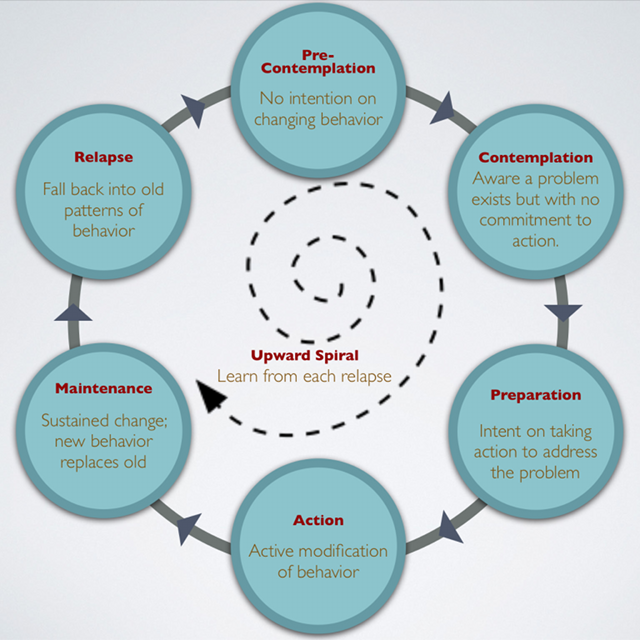
“The Cycle of Change” by Ignacio Pacheco, Social Work Tech, adapted from Prochaska and DiClemente (1983). Licensed under CC BY-NC-ND 3.0. Original article.
The framework was developed through research on addictive and health-related behaviors. Applying it to boundaries, relationships, or life direction is a reflective extension, rather than evidence that every personal decision follows the same pattern. You might find yourself ready to change one behavior while feeling uncertain about another. Naming the specific change matters: “I want a different life” leaves many questions open, while “I want to stop agreeing to commitments before checking my capacity” gives you something concrete to explore.
Precontemplation: Beginning to Notice
In precontemplation, a person is not currently intending to change the behavior. They may not see a concern, may disagree with others’ concerns, or may feel discouraged about whether change is possible. From outside, this can look like indifference. Before drawing that conclusion, it is worth asking what the person understands about the situation and what changing it would mean to them.
Imagine someone who regularly takes on more than they can manage. They may see being dependable as an important expression of care, even as exhaustion grows. The first meaningful risk might be allowing a question: “Is this still working for me?” That question can unsettle an identity built around being available. A useful beginning could be observing when resentment or fatigue appears, without demanding an immediate decision about what to do.
Contemplation: Making Room for Both Sides
Contemplation involves considering change while remaining uncertain about it. The model recognizes the importance of decisional balance: how someone weighs the perceived benefits and costs of changing (Prochaska & Velicer, 1997). Wanting something different can coexist with wanting the protection, familiarity, or connection associated with the existing pattern. Both sides deserve enough attention to be understood.
For the person considering boundaries, saying no might promise more time and less exhaustion. It might also bring guilt, disappointment, or concern about belonging. Useful questions include: “What does saying yes give me?” and “What does it ask me to give up?” It is also worth considering the costs of continuing unchanged. This exploration does not require pretending that every concern is equally likely; it invites distinguishing what has happened before, what is feared, and what remains unknown.
Preparation: Making the Risk More Manageable
Preparation involves developing an intention to act and making practical arrangements. The question becomes more specific: “How could I try this?” A person might gather information, identify support, practice a skill, or decide when and where to begin. Planning gives attention to the conditions under which a change could realistically happen.
Someone preparing to set boundaries might rehearse, “Let me check my schedule before I commit.” They could begin with a relatively manageable request, rather than the most emotionally charged relationship in their life. They might also think through what to say if the other person presses for an answer. This approach leaves room for uncertainty while reducing avoidable difficulty. A useful plan includes a way to review the experience and adjust the next step. For an everyday application of starting small, explore Breaking the Habit of Procrastination.
Action: Trying Something Different
Action involves making observable changes to the target behavior. In the boundary example, this might mean pausing before answering, declining a request, or following through on a limit. Action makes the experiment real: other people can respond, practical consequences can emerge, and the person can discover what the new behavior feels like in everyday life.
Consider a hypothetical response: someone declines an extra commitment, and a friend expresses disappointment. That reaction deserves attention, but it does not settle whether the boundary was appropriate. The person might ask whether the limit reflected their actual capacity, whether they communicated respectfully, and whether anything needs clarification. The aim is to learn from what happened. Treating every uncomfortable response as proof of failure would leave little room to develop a different way of relating.
Maintenance: Continuing When Life Gets Complicated
Maintenance concerns sustaining a change over time. The challenge shifts from initiating a different behavior to supporting it across changing circumstances. A boundary that feels manageable during a quiet week may become harder to maintain during illness, family tension, or financial pressure. What helps in one situation may need adjustment in another.
A maintenance plan might include checking commitments regularly, noticing early signs of overextension, and keeping useful language available for difficult requests. It can also include revising a boundary when circumstances genuinely change. Continuing a chosen practice requires judgment, rather than perfect repetition. Someone who occasionally overcommits can still examine what happened and decide how to respond, without turning one decision into a conclusion about their entire ability to change.
Relapse: Returning to the Process
Relapse means returning to a previous pattern after making a change. In the stages-of-change framework, this can involve revisiting earlier stages, rather than moving through the process only once. It is a possibility, not a required step, and it does not necessarily return someone to precontemplation. Examining what happened can help identify what is needed for another attempt (DiClemente & Crisafulli, 2022).
In our boundary example, someone might begin agreeing to more than they can manage again during a stressful period. They could revisit contemplation to reconsider competing needs, return to preparation to revise their plan, or resume action with additional support. The question becomes: “What made this difficult, and what do I need now?” Learning is possible, but it is not automatic; a setback deserves attention when it carries consequences.
The courage involved may be acknowledging the return of a familiar pattern, asking for help, or trying again without demanding certainty. Previous progress can offer useful experience, even when the next attempt requires a different approach. There is room for responsibility and kindness in the same conversation.
Choosing a Risk That Fits Your Life
A useful way to apply this framework is to ask what kind of uncertainty you are facing. Are you risking embarrassment, another person’s disapproval, financial stability, or physical safety? These are materially different situations. Where coercion, threats, or serious danger are present, the emphasis belongs on safety and appropriate support; a general invitation to “be courageous” is insufficient.
For everyday changes, consider what is meaningful, feasible, and open to review. You might request information before making a commitment, practice a conversation before having it, or try a limited adjustment before deciding on a larger one. Such experiments are practical applications of the framework, rather than a separate, validated risk-taking sequence. They invite you to connect your next step with your actual circumstances.
How Counseling Can Support the Process
You can bring uncertainty itself into counseling. A conversation might focus on clarifying the desired change, understanding competing wishes, considering obstacles, or reviewing an attempt that did not go as expected. Research has found an association between readiness for change and psychotherapy outcomes, although that association does not establish that readiness alone causes improvement (Krebs et al., 2018).
The evidence also calls for flexibility. A Cochrane review of smoking-cessation interventions found no clear additional benefit from staging in the small group of trials directly comparing equivalent staged and nonstaged interventions (Cahill et al., 2010). The stages can offer useful language for exploration while leaving room for other explanations and approaches. They should not become a test someone must pass before receiving help.
Conclusion
The courage to change may begin with a quiet admission: something that once helped you no longer fits as well as it did. From there, your work might involve understanding hesitation, gathering support, trying a different response, or returning to a practice after a difficult week. Each offers something worth noticing.
Consider one change that matters to you. Where are you in relation to it today, what feels at risk, and what would make the next step more workable? You do not need a complete answer before beginning that conversation. An honest understanding of where you are gives you a place to start.
References
Cahill, K., Lancaster, T., & Green, N. (2010). Stage-based interventions for smoking cessation. Cochrane Database of Systematic Reviews, (11), Article CD004492. https://doi.org/10.1002/14651858.CD004492.pub4
DiClemente, C. C., & Crisafulli, M. A. (2022). Relapse on the road to recovery: Learning the lessons of failure on the way to successful behavior change. Journal of Health Service Psychology, 48(2), 59–68. https://doi.org/10.1007/s42843-022-00058-5
Krebs, P., Norcross, J. C., Nicholson, J. M., & Prochaska, J. O. (2018). Stages of change and psychotherapy outcomes: A review and meta-analysis. Journal of Clinical Psychology, 74(11), 1964–1979. https://doi.org/10.1002/jclp.22683
Prochaska, J. O., DiClemente, C. C., & Norcross, J. C. (1992). In search of how people change: Applications to addictive behaviors. American Psychologist, 47(9), 1102–1114. https://doi.org/10.1037/0003-066X.47.9.1102
Prochaska, J. O., & Velicer, W. F. (1997). The transtheoretical model of health behavior change. American Journal of Health Promotion, 12(1), 38–48. https://doi.org/10.4278/0890-1171-12.1.38