Introduction: What Are Needs?
Within Nonviolent Communication (NVC), human needs are understood as universal motivations that influence our feelings, choices, and relationships. Unlike strategies—the particular actions we take to meet our needs—needs represent underlying qualities and experiences that people seek, such as connection, autonomy, safety, and meaning. Nonviolent Communication provides a framework for understanding feelings and needs, distinguishing universal needs from the strategies we use to meet them, and making requests that support mutual understanding (Rosenberg, 2015). When we become aware of what we need—whether it is connection, autonomy, safety, or meaning—we can better understand why certain situations are challenging and how to address them more effectively.
Why Needs Matter in Everyday Life
Within the NVC framework, feelings such as anxiety, frustration, or loneliness can invite us to explore whether important needs are unmet or only partially met. Although emotions have many possible influences, reflecting on our needs can offer a useful way to understand our experiences.
For example:
You might feel isolated when you need connection or belonging.
You might feel stuck when you crave autonomy or choice.
You might feel overwhelmed when you need rest or ease.
In NVC, emotions are understood as potential indicators of whether important needs are being met. Rather than assuming that any particular feeling identifies a specific unmet need, we can use our emotional experiences as starting points for curiosity and reflection.
A Practical Guide to Identifying Your Needs
Here’s a simple four-step process you can use, whether you’re journaling, reflecting with a therapist, or working on relationships:
1. Notice What You’re Feeling
Start by observing your emotional and physical sensations. Use specific feeling words rather than general ones like “fine” or “bad.” The clearer you are about your feelings, the easier it becomes to connect to the underlying need.
Examples: “I feel overwhelmed,” “I feel lonely,” “I feel sad.”
2. Explore What Your Feelings Are Telling You About Your Needs
Once you name a feeling, ask yourself: “What need might be unmet or met right now?”
Needs are universal. You might find that a feeling like loneliness points to a need for connection, support, or empathy. A sense of being criticized may reflect a need for respect or understanding.
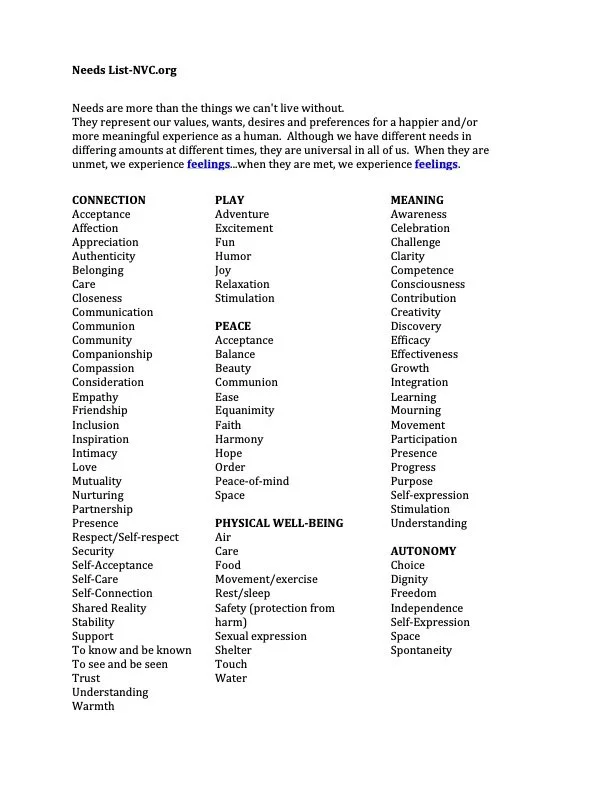
Below are common clusters of needs — this is not exhaustive, but a helpful starting point:
Connection & Belonging: acceptance, empathy, appreciation, inclusion.
Autonomy: choice, freedom, space.
Safety & Security: predictability, stability, emotional safety.
Meaning & Purpose: growth, clarity, contribution.
Physical Well-Being: rest, nourishment, movement.
Play & Joy: fun, humor, adventure.
You can use a needs inventory list as a reflective tool when you feel stuck—it expands your emotional vocabulary and helps you see patterns. The below needs list identifies needs more specifically, organized by categories.
3. Notice What Helps You Meet Those Needs
Once a need is named, shift attention to strategies, the actions that help meet your needs. For example:
If you need connection, a strategy might be talking to a friend, joining a group, or scheduling quality time with someone you trust.
If you need rest, a strategy might be adjusting your schedule to include a short walk, a nap, or a relaxing routine before bed.
It’s important to distinguish needs from strategies — needs are universal, strategies are the specific ways we try to meet them.
4. Make Requests (to Yourself or Others)
Once you understand your needs and possible strategies, consider what you could ask for that might help meet those needs in a respectful and realistic way.
A request in NVC is not a demand. It is a clear, actionable, and compassionate invitation for support or cooperation.
Example: “Would you be willing to spend 20 minutes talking with me after dinner tonight?”
Requests can also be to yourself: “I will take a 10-minute break right now to stretch and breathe.”
Using Needs Awareness to Navigate Life’s Challenges
This approach can help in many areas of life:
Relationships: When you and someone you care about are in conflict, identify the needs beneath both of your feelings. Often misunderstandings happen because we react to strategies rather than the needs underneath.
Personal Stress: When anxiety or frustration rises, exploring the different parts of ourselves that experience these emotions can help us recognize underlying needs, such as rest, clarity, or support.
Decision-Making: Decisions rooted in an understanding of your core needs often feel more fulfilling than those driven by impulse or avoidance.
Conclusion: Living With Awareness and Compassion
Understanding your needs is an ongoing practice — one that invites curiosity rather than judgment. By connecting feelings to universal needs, you gain insight into why you react the way you do, and you unlock compassionate choices that support your well-being and relationships.
As you practice noticing feelings, naming needs, and exploring requests—both for yourself and in communication with others—you can cultivate greater empathy, self-understanding, and the ability to live in accordance with your values.
References
Rosenberg, M. B. (2015). Nonviolent communication: A language of life (3rd ed.). PuddleDancer Press.
Resource
NVC Needs List